The Doctoral Programme in Theology enables students to develop research that helps to form their own theological thinking and contributes unique elements to the development of theological knowledge.
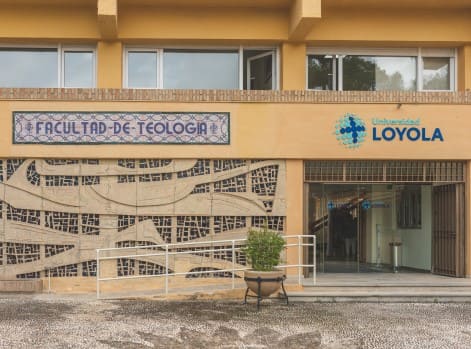
The Doctoral Programme in Theology at the Faculty of Theology of Granada, recently integrated into Loyola University, offers its doctoral students the possibility of choosing from a catalogue of training, seminars and courses that will help them to strengthen their research capacity. Doctoral students will be able to participate in academic sessions of the Department of Theology and will communicate their research results in publications, conferences and congresses.
Thus, at the end of the process, the doctor will be able to position themselves in the scientific community with a good command of the method of scientific research typical of theology. With these skills, from an identity of their own, graduates will be able to respond to the challenges of today's world, to the understanding of dogma and evangelisation, as well as to communicate their knowledge to the scientific community.
The Doctor of Theology degree qualifies students to teach in ecclesiastical faculties and universities, in higher institutes of religious sciences and in universities with faculties in the field of humanities. It also qualifies them for tasks as advisors and consultants in theological matters of the different levels and ministries of the Catholic Church; in publishing houses with religious topics; in educational and social platforms and foundations of consecrated life, lay associations, ONGED...
The doctorate in theology is an ecclesiastical degree that is eligible for equivalence with the Spanish government, and therefore has value within the framework of the European Higher Education Area.
This doctoral programme is addressed to people who wish to teach in the fields of humanities and ecclesiastical studies or who wish to be qualified as advisors and consultants in theological matters

Theology and the contemporary world |
The Christian faith is always called to express its message in the confines of the culture in which it lives. If the key to theological work is to be found in the moment of hermeneutical mediation, this is only possible by seeking to articulate a twofold faithfulness: to the time in which we live and to the revelation of God in Christ. Thus, the object of theology is none other than to bring about an encounter between the God of Jesus and the man of each age.
Catalogue of possible topics for doctoral theses
Christianity and Islam |
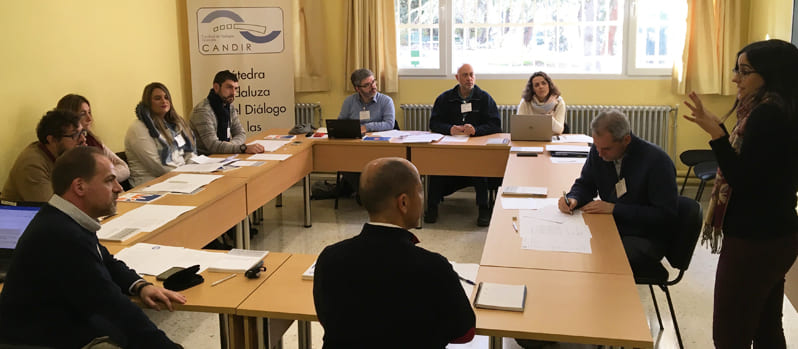
The Faculty of Theology in Granada, due to its location, has been particularly interested in the Muslim-Christian dialogue since ancient times. Its Andalusian Chair for the Dialogue of Religions (CANDIR) proposes, on the one hand, an interdisciplinary reflection and research on religions, with special attention to Islam and its presence in contemporary Spain, as well as the dialogue of Catholic theology both with this religion and its own knowledge and culture; on the other, the need to design an analysis of the problems posed by the religious and cultural plurality of open societies.
Catalogue of possible topics for doctoral theses
Research teams of recognised prestige
In person and virtual training, compatible with other activities
You will gain the ability to analyse a systematic, dialogical and apostolic theology
Personalised academic guidance and support through a tutor
Its aims include interdisciplinary reflection and research on bioethics issues, as well as the dialogue of Christian faith with culture and the scientific world, with special emphasis on the Andalusian region.
Director: Francisco José Alarcos Martínez
Its aims include interdisciplinary reflection and research on religions, with special attention to monotheistic religions, as well as the dialogue of Catholic theology with both the field of sciences of religion and with the knowledge typical of the religions and the cultures in which they are interwoven, with special emphasis on the Andalusian region.
This chair is part of the Pluriel network of researchers on Islam in Europe and Lebanon.
Programme director: Jaime Flaquer García

If your past efforts are reflected in your marks, you’ll have the opportunity to obtain one of the 10 prizes we award, which can cover up to 100% of the programme cost.
Further, Loyola University has a wide range of scholarships and financial aid so that nobody who is fulfilling their academic requirements will have to stop studying for financial reasons. The scholarships and financial aid packages for studying at Loyola University are established with the university’s own funds.
Loyola University has signed agreements with financial institutions to facilitate students’ access to undergraduate, postgraduate, executive and doctoral studies.
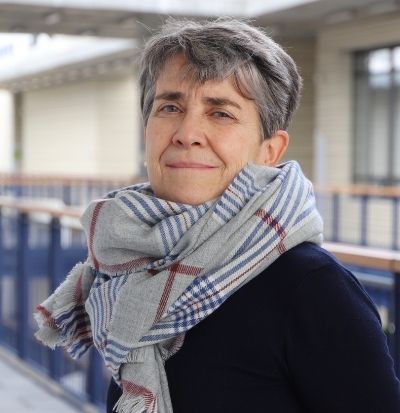
Miren Junkal Guevara. Coordinator of the PhD Program in Theology
Graduate in Law from ICADE at Comillas Pontifical University, and PhD in Theology, specializing in Biblical Theology from the Faculty of Theology of Granada. Full Professor at Loyola Andalusia University. Specialist in the Pentateuch and the historical books of the Old Testament, as well as in the history of ancient Israel.
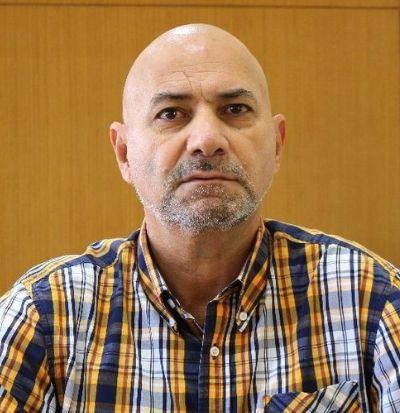
Jair Fante. PhD Candidate in the PhD Program in Theology
“The doctoral thesis, currently being developed at the Faculty of Theology in Granada, is a great learning opportunity, both in terms of its content and its methodological dimension. As a professor at the Catholic Faculty of Mato Grosso, Brazil, I am very grateful and pleased that the institution in Granada has so generously opened its doors, making it possible to carry out this doctoral research on the rapprochement between logotherapy and liturgy. There is no doubt that this international exchange has greatly enriched the research work currently underway. My most sincere thanks.”
Possibility of establishing a collaboration with the research groups at Loyola University from the time you embark upon your dissertation, as well as with companies and organisations with R&D departments. You will enjoy research stays, grants and precise and personalised activities based on the profile of the doctoral students working on their dissertations.

All doctoral programmes at Loyola University include research courses, seminars, conferences and workshops that contribute to developing their necessary academic skills.

You will have the chance to reap the benefits of the teaching and research experience of professionals with high-impact studies, R&D projects and management of PhD dissertations. Loyola Doctorates also works with an impressive list of collaborators with recognised academic prestige in each field.

At Loyola Doctorates you can present your dissertation with international mention, with joint tutoring from other institutions or universities, or you can do an industrial doctorate.

The Seville Campus is the only campus in the world that has been honoured with LEED Platinum environmental certification, thanks to its deep commitment to the comprehensive sustainability of the entire grounds. There is a free wi-fi connection on the entire campus, study rooms, a modern library, terraces for resting and relaxing, a cafeteria, landscaped areas for strolling, sports facilities.
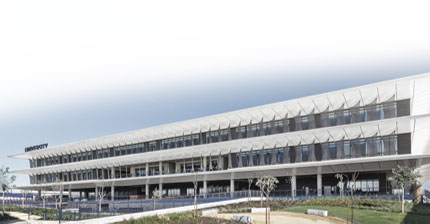
Our Jesuit identity unifies us in a network of over 230 universities throughout the world with an unmistakable background and prestige, which endorses our social mission. Loyola University is a member of UNIJES and the International Association of Jesuit Universities (IAJU).

c) The Academic Committee's functions with regard to the supervision of the Doctoral Program are:
i) To organize and coordinate the training and research activities of the Doctoral Program.
ii) To plan and evaluate the acquisition of skills by doctoral students in the Doctoral Program.
iii) To propose to the School Board new lines of research to be incorporated into the Doctoral Program, the maximum number of students to be admitted, and to define the criteria for their selection.
iv) To inform the School Board about the candidates to be admitted to the Doctoral Program.
v) Advise the EDOC on the additional training required for students who need it.
vi) Manage, monitor, control, and evaluate the mobility activities of the Doctoral Program.
vii) Advise the School Board on any additional requirements that may apply to the incorporation of new research groups and the supervision, direction, and reading of doctoral theses.
viii) Report on the incorporation and separation of professors in the Doctoral Program.
ix) Monitor doctoral graduates from the Doctoral Program.
x) Provide and manage the information necessary to maintain the accreditations of the Doctoral Program, as well as that necessary for the University's quality systems. Specifically, it is the responsibility of the Academic Committee to keep the information on the Doctoral Program up to date on the University's website.
xi) Resolve all issues relating to the Doctoral Program.
xii) Any other function that may be assigned to it by the EDOC Management.
d) The Academic Committee's functions with regard to doctoral students are as follows:
i) To monitor, control, and evaluate the Activity Documents of doctoral students, their Research Plans, and their annual Monitoring Reports.
ii) To assign the tutor and director of the students' Doctoral Thesis.
iii) To approve the students' first doctoral thesis project.
iv) To authorize part-time doctoral studies, as well as to authorize changes in study mode.
v) To evaluate co-supervision proposals and report to the School Board.
vi) To ensure that theses submitted for reading meet the minimum requirements.
vii) Authorize requests for international recognition.
viii) Propose to the School Board the members of the committee that will evaluate a doctoral thesis, determining the permanent and alternate members.
3) The Academic Committee of a Doctoral Program may be dissolved by the Rector.
| Year 2020/21 | Year 2021/22 | Year 2022/23 | Year 2023/24 | Year 2024/25 | Year 2025/26 |
| 08/02/21 | 08/09/21 | 05/09/22 | 07/09/23 | 02/10/24 | 16/09/25 |
| 15/02/21 | 20/10/21 | 27/09/22 | 18/09/23 | 19/12/24 | 20/10/25 |
| 05/03/21 | 01/12/21 | 10/10/22 | 09/10/23 | 29/01/25 | 27/11/25 |
| 08/06/21 | 26/01/22 | 21/11/22 | 29/11/23 | 20/02/25 | |
| 23/03/22 | 29/11/22 | 14/03/24 | 18/03/25 | ||
| 24/06/22 | 24/05/23 | 09/07/24 | 31/03/25 | ||
| 14/07/22 | 29/06/23 | 16/07/24 | 23/06/25 |
| May | Week of 10th to 14th |
| June | Week of 8th to 10th |
| July | Week of 6th to 9th |
| September | Week of 7th to 9th |
* These dates may be subject to change if decided by the Academic Committee.
Profile 1: Without further training
Hold the canonical degree from the Faculty of Theology of Granada with a minimum grade of 8 out of 10 or equivalent, or from other faculties of theology whose curriculum is equivalent according to the Academic Committee.
Profile 2: With further training
Hold a canonical degree from another Faculty of Theology with a minimum grade of 8 out of 10 or equivalent. The Academic Committee for the Programme, depending on the training curriculum and the subject of the thesis, may assign further training courses for at least 6 ECTS and a maximum of 15 ECTS that must be taken from the following catalogue:
Languages required and level:
Demonstrate a knowledge of English at a sufficient level to handle the corresponding scientific bibliography for the development of their doctoral thesis and at the decision of the Academic Committee.
If you cannot prove that you have studied at university in Spanish or that you have worked and lived for some time in Spain or in another Spanish-speaking country, you must prove that you have a sufficient level of Spanish to be able to perform your studies. The Academic Committee will be responsible for assessing whether your language level is sufficient.
For Sacred Scripture students, proficiency in Latin, Greek and Hebrew, which will be assessed by the Academic Committee.
Those who cannot accredit their language level by means of the pertinent certificate will be given a test to assess their proficiency
Informative documentation related to the official nature of the degree: Link to the Register of Universities, Centres and Degrees (RUCT).
Royal Decree 1619/2011, of 14 November, establishing the new system of equivalencies for university-level studies and degrees in Ecclesiastical Sciences with regard to official Spanish university degrees, in compliance with the provisions of the Agreement between the Spanish State and the Holy See of 3 January 1979 on Education and Cultural Affairs. (boe.es)